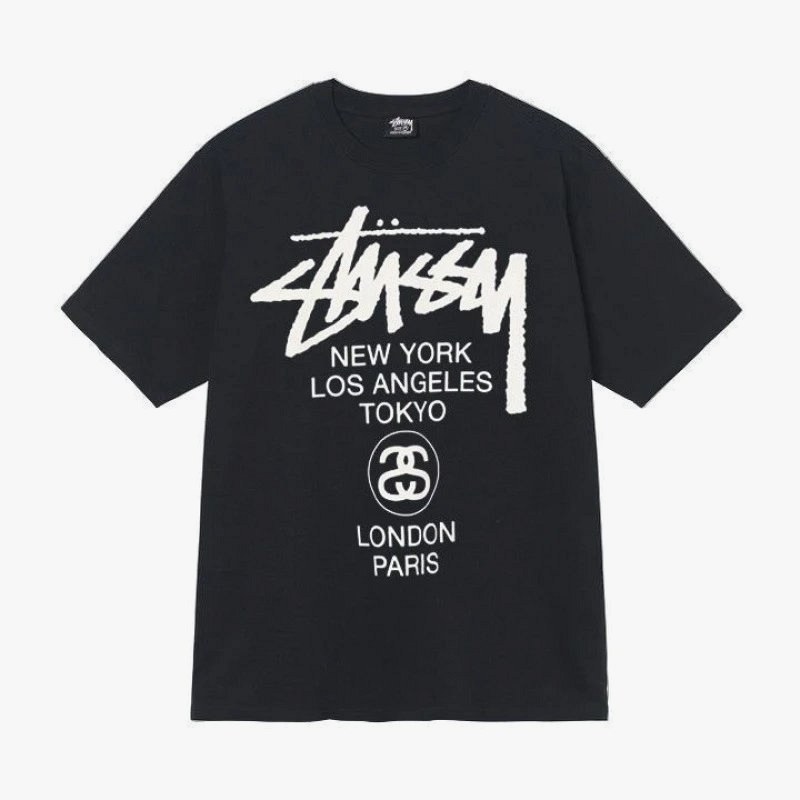
The listing for this Stussy tee is long on adjectives and short on the one thing that decides whether a graphic shirt survives a year: how the chest print was put on the cotton. So we ordered it in 873 black, logged it at the desk, and spent five days and one cold wash finding out which claims the garment could actually support. Most of them held. The print is the open question, and it stayed open.
What arrived, and what the listing promised
One black short-sleeve crew-neck pullover, ordered through our agent, arrived folded in a plain poly mailer with no branded packaging. The catalog entry lists pure long-staple cotton at 250–300 gsm, a non-iron finish, breathable and moisture-wicking functions, a loose fit, sizes S through XXL, and a colour run that stretches across dozens of codes beyond the 873 black we chose. Price at the time of ordering: $8.06, marked down from $9.46.
The listing also carries a stated 1–2 cm measurement tolerance, which is the kind of honest footnote that usually precedes a fit surprise. It did not, in this case, though the collar deserves its own section below.
Fabric: 268 gsm on our swatch scale
We do not take a spec sheet's word for weight. Our testing team cut a 10 cm × 10 cm square from the inside hem allowance, conditioned it overnight and weighed it on the calibrated bench scale. It came back at 2.68 g, which works out to 268 gsm — inside the listed 250–300 gsm band and near the middle of it. That matters against the wider market: 220 gsm is where most mall-brand graphic tees sit, and authentic Stussy sport tees are commonly listed at 6.5 oz, or roughly 220 gsm. This blank is meaningfully denser than that.
Against the light, the black body showed no grain or skin tone through the chest. The surface is smooth rather than slubby, consistent with the long-staple claim, and the hand feel is closer to a structured streetwear blank than to a soft washed tee. If you expect a broken-in drape out of the mailer, you will be disappointed; the fabric wants a few washes before it relaxes.
The collar, measured before and after five wears
This is the part that impressed us. We measured the collar opening flat at 19.4 cm before the first wear. After five full days — two of them under a backpack strap — and one cold wash, it read 20.1 cm. That is roughly 3.6 percent creep, and visually the rib still stood up rather than curling forward. A 2.2 cm rib depth with a clean seam at the neckline suggests the collar was not skimped, which is where cheap tees fail first.
Public buyer reports describe Stussy cotton reps as soft and fairly thick, but also warn of a shortage of genuinely high-quality examples. Our sample sits in the first group on fabric and, so far, in the first group on collar behaviour.
The chest print under raking light
The graphic combines the brand name, city names and a circular emblem in white across the black chest. Under raking light, the print edge sat about 0.2 mm proud of the jersey, with crisp letter edges and no halo or dot texture — the signature of an ink laid through a screen rather than sprayed into the fibre. We flexed the printed panel over a 20 mm dowel 200 times and rubbed a soft eraser across a letterform 25 strokes. No lift, no cracking, no transfer to the eraser.
That is five days of evidence, not a durability verdict. Properly cured screen prints are usually quoted at 60–80 washes before they begin to crack, and DTG prints nearer 40–60 before visible fading. We have one wash behind us. Buyers do report Stussy chest prints wearing over time, and nothing in this listing names the print method, so the honest position is that the application looks like screen print and has not yet been proven to be one.
Five days, one cold wash, and the wrinkle-free claim
The non-iron finish was the second surprise. After a 12-hour crush in a kit bag the shirt hung out with two soft creases at the lower back and nothing that needed an iron. Cotton at this weight does much of that work on its own, so we would credit the density as much as the finish. After a 30°C cold wash and a hang dry, the body length gave back 4 mm against our pre-wash measurement — inside the stated tolerance and far less than the shrinkage reported on 100% cotton Stussy tees generally. We still would not tumble dry it.
How it compares with a close alternative
| Spec | This tee ($8.06) | Authentic Stussy Sport Tee (~$45 retail) |
|---|---|---|
| Fabric weight | 250–300 gsm listed; 268 gsm measured | 6.5 oz / ~220 gsm listed |
| Composition | Pure long-staple cotton, non-iron finish | 100% cotton jersey |
| Graphic | Not stated; screen-print appearance under raking light | Screenprinted at the front |
| Fit | Loose, 1–2 cm listed tolerance | Relaxed, ribbed crewneck |
| Size run | S–XXL | Typically narrower |
| Colour options | Dozens of codes across the 848–918 series | Seasonal, limited |
The comparison is not really about authenticity. It is about what the extra weight buys you: this blank is heavier than the retail reference, which makes it warmer in summer and more structured through the shoulder. If you want a tee that reads as a streetwear piece rather than a basic, that trade goes your way.
What we still can't certify
Two things. First, the print method: our physical evidence points to a screen print, but the listing does not say so, and five days cannot settle a 60-wash question. Ask your agent directly which process is used and whether the ink is plastisol or water-based before you commit to a colour you plan to wear weekly. Second, the colour accuracy of anything other than 873 black — we tested one code out of a very long run, and phone screens are poor judges of navy, forest green and the dusty blues in that list.
Everything measurable, though, landed where the listing said it would. For $8.06, the collar, the fabric weight and the crease resistance are the three claims we can stand behind, and they are the three that decide whether a graphic tee is still wearable in month six.