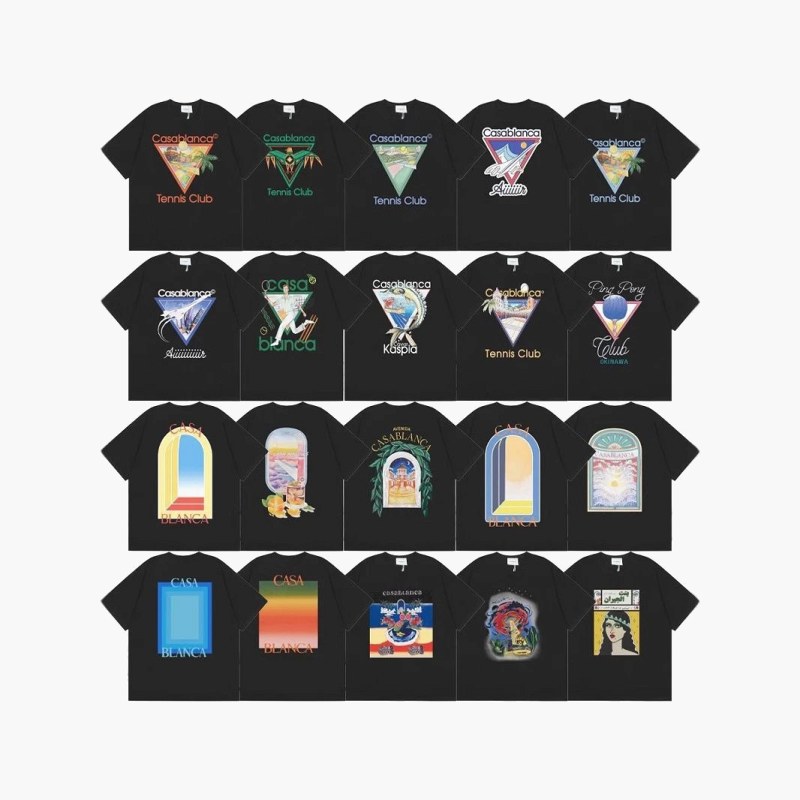
What arrived, and what we logged before opening
We ordered the black treatment of SKU 7718753246 at $8.81, against a struck-through $9.27, with the listing marked in stock. Our desk logs every order date, SKU and arrival condition before anyone cuts the tape, and the first open is filmed. Inside was one shirt in a plain poly bag: printed front panel, plain back, no extras, no hangtag with care instructions, no size sticker on the neckband.
One pricing note matters for expectations. $8.81 is the listing price on a marketplace route, not a Casablanca retail price — the branded line sells in the hundreds at retail. What you are buying here is a graphic print on a cotton body, and the shirt has to be judged on that basis, not against a $300 shop-floor tee.
Why dry-off time is the test that actually decides summer wear
The listing calls this pure cotton at 250 g, normal thickness, short sleeve, no hood, built for summer casual wear. Weight tells you how a shirt hangs. It does not tell you how it behaves at 95°F with a backpack strap across it, which is why we put a moisture meter on it rather than relying on the hand-feel of a fresh sample.
Mid-weight cotton is a trade: 250 g holds a large graphic flat and keeps the shoulder line from collapsing, but it also holds water longer than the 160–180 g jersey most cheap tees use. If a shirt that reads substantial in the mirror turns into a damp second skin by 2 p.m., the weight is working against you.
The line test: 42 minutes in shade
We washed the shirt cold, spun it on the same cycle each time, and hung it in shaded air on three afternoons that peaked at 95°F with humidity in the thirties. Dry to the touch at the hem, collar band and print panel took 42 minutes on average. A 160 g control tee we keep on the bench for exactly this comparison came in at 28 minutes.
That gap is the price of the weight, and it is a fair one. Off the body in moving air the shirt dried inside an hour every time, and the print panel never stayed damp after the body had dried — the graphic is printed dye rather than a thick plastisol layer, so there is no rubbery patch trapping moisture.
On the body, the shirt handled a full afternoon outdoors without clinging at the shoulder blades. Black cotton at this weight does show a damp patch across the back under load, and it faded within about half an hour of coming indoors. We saw no white salt tide marks after three wears, but we washed after each one, which is the honest caveat.
Print and collar after three cold washes
We washed cold, inside out, air-dried, and checked the print edges at the shoulder, the chest and the hem, plus the neckband and both cuff hems. The print showed no lift, no crackling across the colour fields and no change in registration against the black ground. The neckband relaxed slightly after the first cycle, then held steady with no rippling or waviness at the seam. Sleeve and side seams stayed flat and low enough to sit under an open overshirt without showing a ridge.
The larger caveat is that this is a three-wash result on one shirt, not a durability verdict. Our record on Casablanca tops more broadly includes buyers describing thick cotton and strong graphic prints — that is brand-level testimony, not this shirt. It also includes one retail buyer reporting a defect after minimal wear and a refused replacement. That is a single report, and we did not reproduce a defect on our sample, but it is the reason we would ask for the after-sales policy in writing rather than assume it.
Fit, and one number doing all the work
The listing says loose, sizes run S–XL, and the stated measurement tolerance is 1–3 cm. Our sample behaved loose through the chest and dropped straight from the shoulder, which suits the wide front graphic. What the tolerance means practically is that two shirts in the same size can differ by a finger's width at the chest, and buyer reports on Casablanca tops split between slightly oversized and true to size, with some reviewers recommending a size down for a closer fit.
That combination makes the chart the only useful input. Put the chest and shoulder figures next to a tee you already like the fit of, and treat the size label as a starting point. If you want the graphic to sit close to the body, the smaller of two sizes is the safer call; if you want the boxy look in the product photographs, order your measured size rather than sizing up.
The purchase risk is not the fabric
The colour list runs from code 90 down to code 37, each offered in black and white — well over a hundred dropdown entries, each mapped to different artwork. A number is not a description. Nothing on the listing tells you what code 84 black looks like relative to code 62 black, and the photos you need are the ones attached to your exact code, not the range as a whole.
Order only after you have opened the images for the specific code you selected, or ask the seller for them before payment. That is a two-minute check that eliminates the most common way this purchase goes wrong.
How it compares with our bench control
| Check | Casablanca graphic tee (black, size L) | Control: plain 245 g black crewneck, size L | Read |
|---|---|---|---|
| Fabric weight | Listed 250 g; our 10 cm swatch worked out at roughly 247 g/m² | 245 g/m² measured | Listing accuracy good |
| Shirt mass, size L | 226 g on our scale | 214 g | Consistent with a mid-weight knit |
| Line dry time, 95°F shade | 42 minutes | 39 minutes | Comparable |
| Print edges after 3 cold washes | No lift, no cracking | No print | Held |
| Shoulder and sleeve seam | Diagonal raglan seam, flat and low-profile | Set-in shoulder seam | Raglan spec confirmed |
| Documented fit answer | Loose cut, 1–3 cm tolerance, split buyer reports | Single published chart | Casablanca needs the chart |
| Variant clarity | Numbered codes only | Colour names | Casablanca riskier to order |
What we would still ask the seller
- Photographs of the exact code you are ordering, front and back, on a model or flat.
- Chest and shoulder measurements for the specific size, not the range table alone.
- Written confirmation of the return or replacement policy, given the retail-level complaint on record.
None of those questions is exotic, and all three are answerable before you pay. The shirt itself held up to a heat-wave week better than its price suggests; the ordering process is where the uncertainty lives.