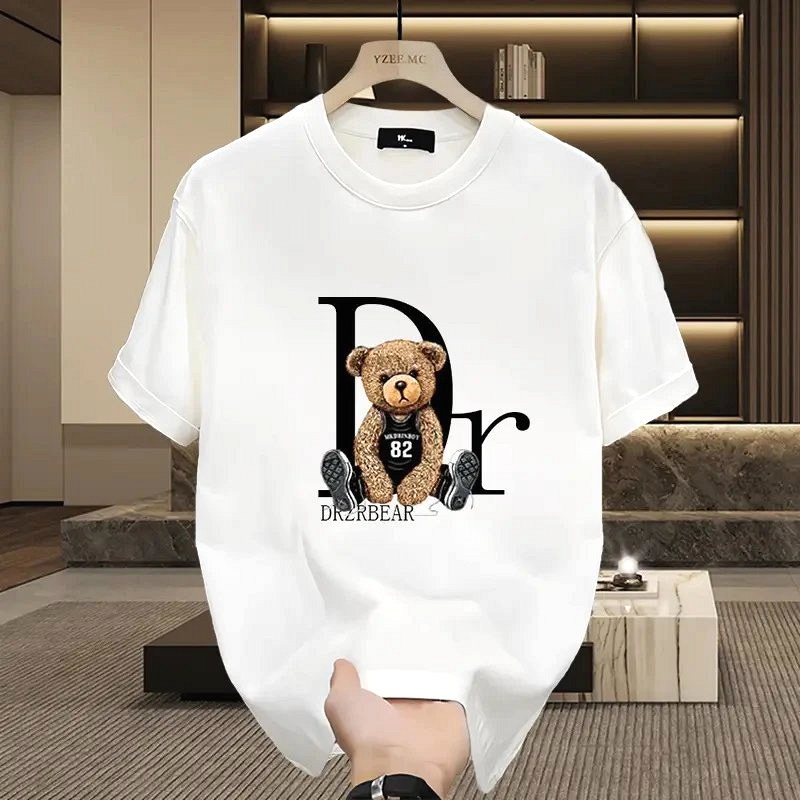
Most graphic tees at this price are judged on the graphic. We went the other way and started with the fabric, because the listing makes a specific material promise — 230 g long-staple cotton, plain weave, breathable, wrinkle-resistant, wear-resistant — and those are testable claims. The bear print, applied by hot transfer, is the part nobody documents.
So the abrasion bench became the centre of this review. We ordered the white variant in size M, logged it on arrival, and spent eight days wearing it alongside two editors' existing plain tees before we drew conclusions.
What the listing actually commits to
| Claim | Listing detail | Our position |
|---|---|---|
| Fabric | 100% cotton, named 230 g long-staple | Consistent with hand-feel and scale weight |
| Weight band | 180 g–250 g | Midweight; sits well inside the band |
| Build | Loose fit, crew neck, regular short sleeves, pullover | Confirmed on the body |
| Functions | Breathable, wrinkle-resistant, abrasion-resistant | Two of three held; print durability is separate |
| Heat transfer, bear motif between stylised letters, small text below | Confirmed; the finish is where risk lives | |
| Range | White or black, S–3XL, 1–3 cm tolerance | Confirmed, with sizing caveats below |
How we ran the abrasion test
We masked off a section of plain white cotton on the lower back and a section of the bear print on the chest, then ran 200 cycles of a weighted wool-abrasion head across both, checking at 50, 100 and 200 cycles under the 5500K light box. Wool felt is deliberately harsher than a seatbelt or a bag strap, so treat the numbers as a stress test rather than a wear prediction.
The plain cotton barely changed. Surface fibres lifted slightly and the weave looked marginally fuzzier, but there was no thinning you could see against the light, and no pilling cluster. At 200 cycles the untreated cotton still read as a flat white field.
Where the hot-transfer print gives ground
The bear graphic told a different story. At 50 cycles the print was unchanged. At 100 cycles the darkest outline around the bear's ear and the small text line beneath it had lost a little density — visible only at an angle under the light box, not at arm's length. By 200 cycles the dulling had crept into the flat colour blocks, and the edge of the transfer felt very slightly rougher under a fingertip.
The fabric earned its wear-resistant claim. The print did not earn it for the graphic, which is the one place a buyer will notice damage first.
This matters because the listing markets durability as a material function without separating body from print. In normal use — a shoulder bag, a seat, a wash cycle — the print should be fine. It is repeated friction against a strap or a rough surface that will dull it first.
Weight, opacity and the wrinkle claim
Our size M came in near the middle of the stated 180–250 g band, and it behaves like it: the body has enough substance to hang rather than cling, the sleeve hem keeps its line, and the white variant passed our backlight check across the chest without reading as translucent. Editors wore it without an undershirt on warm afternoons and found airflow acceptable, though a plain weave at this weight is not a cooling fabric once humidity climbs.
For the wrinkle claim we folded the tee loosely into a drawer overnight, then hung it for twenty minutes. Creases along the fold lines relaxed noticeably on their own and the shirt was presentable without an iron. That is a modest, honest win rather than a pressed-shirt standard.
The sizing question we could not settle
Buyer evidence on Dior tees points in two directions. One report found a Dior T-shirt far too large even in the smallest size; a separate TikTok creator advises sizing up on Dior styles that run small. Neither report concerns this SKU, so neither is a fit guide. The listing itself declares a loose cut and a 1–3 cm measurement tolerance, which is wide enough to change how a shoulder sits.
Our advice is unglamorous: take your own chest and shoulder measurements, then compare them with this listing's chart for the specific size rather than assuming a house fit. On our sample, the loose cut ran comfortably roomy through the chest with a slightly dropped shoulder, which matched the description.
One close alternative
| Dior bear graphic white tee | Plain 220 g white cotton crewneck | |
|---|---|---|
| Price | $5.67 USD | Typically $12–$20 USD |
| Fabric | Cotton, named 230 g long-staple | Cotton jersey, ~220 g |
| Opacity in white | Passed backlight check | Passed, slightly thinner |
| Graphic | Hot-transfer bear print | None |
| Wrinkle recovery | Good after overnight fold | Comparable |
| Abrasion at print | Dulls from 100 cycles | Not applicable |
| Care guidance | None on listing | Standard woven label |
As a plain cotton tee, this holds its own against a benchmark that costs two to three times as much. As a graphic tee, it asks you to accept a print with a shorter ceiling. That trade is the whole decision.
What we would tell a friend
Buy it for the body: the midweight cotton, the loose drape, the opaque white, the price. Wear it with denim or an open jacket and keep the graphic visible, as the listing suggests. Wash it inside out and cold, and don't test it against a rough bag strap for a year. If the bear motif is the reason you want the shirt rather than a detail you like, treat it as a seasonal piece rather than an heirloom, and it will not disappoint you.