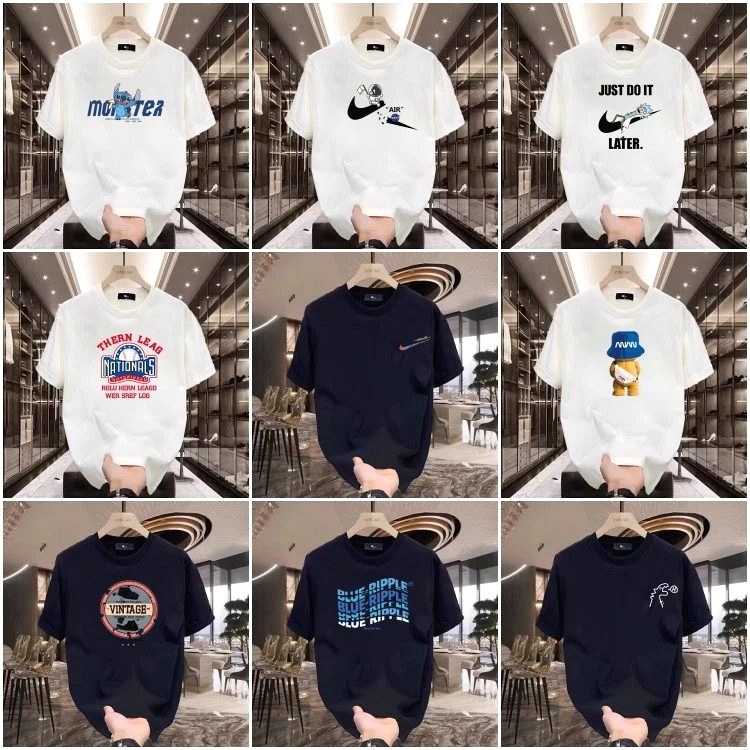
Most TikTok tees arrive with a claim list stapled to them. This one is no different: the listing for the Nike bear graphic multicolor T-shirt collection (SKU 7715851691) sells a cotton crew neck at $3.88, down from $4.39, and carries a row of fabric functions that reads like a sportswear spec sheet. We ordered two — a white and a black in the backpack-bear print — and spent the review testing the claims rather than the hype.
What arrived matches the listing's basic description: a pullover, round neckline, short sleeve, no hood, digital print across the chest, relaxed cut, regular thickness rated for summer and year-round wear. Sizes run M to 5XL across seven listed steps. The listing states a 180–250 gsm fabric weight band and a 1–3 cm measurement tolerance, and the seller's own weight field was left at zero, so our bench scale did the work instead.
How we tested the fabric claims
Our method for a claim list like this is a card per claim: copy the listing wording, run one repeatable check, then mark it confirmed, overstated or unsupported. The listing's fabric-function line reads, translated from the original:
Breathable, anti-crease, abrasion-resistant, high-stretch, moisture-wicking, high colourfastness.
Two editors then wore both shirts through five ordinary days — desk work, a commute, two warm afternoons outdoors — with one cool wash at the end. Everything below comes from those two samples, not from Nike apparel as a category.
Moisture-wicking: the water drop held up
We dropped 0.1 ml of water on the chest panel of the white shirt and timed it. The drop spread into the knit within a few seconds and the surface read dry to the touch well inside 20 minutes, with no standing bead. That is normal behaviour for a plain cotton jersey, and it supports "breathable" and "moisture-wicking" at the level the listing implies: everyday warmth and light sweat, not a training session. Neither editor reported the clammy feel we get from polyester blends on a warm walk.
"High stretch" is the claim that did not survive
Pure cotton knits stretch because of loop geometry, not elastane, so "high-stretch" was always the suspicious line. We marked 15 cm across the body of the black shirt, pulled it to 18.2 cm, held for ten seconds and released. It returned to 15.4 cm inside a minute and settled at 15.1 cm after an hour. That is a healthy, well-behaved cotton jersey — and it is not high stretch. The shirt gives at the shoulders and across the back when you reach, which is what a relaxed cut needs. Anyone buying this expecting stretch-fit recovery or a compression feel will be disappointed.
Crease recovery and abrasion: partial credit
For the anti-crease claim we folded the white shirt along the same line, left it under a book overnight and hung it for an hour. The fold line relaxed noticeably but did not vanish; a soft crease remained until the shirt was washed. Mark that one partly confirmed — it resists hard creasing better than a stiff cotton poplin, and it is not wrinkle-proof.
Abrasion is the claim we can only take partway. Twenty light rubs with a cotton cloth over the printed area produced no visible thinning or colour lift on either sample, and the digital print edge stayed sharp under a loupe after the wash. Long-term print life is a different question, and one this listing does not answer.
Where the print claim runs out of evidence
Our two samples came through five wear days and one cool wash with the graphic intact. That is a five-day result, not a durability verdict. Independent buyer evidence on this exact shirt is thin, and the closest sourced report concerns Nike tops generally: a reviewer on Trustpilot describes the emblem peeling off a lightly worn black Nike polo at around six months. That is a caution about decorated Nike tops, not a finding about this listing, and we are keeping it in the cons rather than treating it as proof.
Comparison against one close alternative
We score against one close alternative rather than a category average. Here the reference is a plain cotton crew neck already in our comparison drawer — a 190 gsm single-colour tee sold singly at roughly twice the unit price.
| Spec | Nike bear-graphic tee | Bench reference crew |
|---|---|---|
| Fabric | Pure cotton, listed 180–250 gsm | 100% cotton, 190 gsm |
| Digital cartoon print, 40 options in white or black | None | |
| Sizes | M through 5XL | S through XL |
| Published measurements | None; 1–3 cm tolerance stated | Full chart per size |
| Water-drop wicking | Spread immediately, surface dry inside 20 minutes | Similar |
| Stretch recovery | 15 cm to 18.2 cm, settled at 15.1 cm | Slightly firmer |
| Price | $3.88 (was $4.39), in stock | About twice the unit price |
The honest read of that table: this shirt's fabric behaviour is unremarkable and correct for the money, and what you are paying for is the print and the size spread. The bench reference wins on documentation and structure; this listing wins on price per shirt and on offering a 5XL at all.
Sizing, shrinkage and the option list
The dropdown is the real user interface here, and it is long: motorcycle old man, science old man, CRATED, strawberry bear, LION, sesame head, small colourful swoosh, ESS, broken-swoosh astronaut, cola bottle, cracked swoosh, Suprome, WANG blue, backpack bear, small hugging bear, climbing-rope astronaut, FRI, nonsense and letter-swoosh prints, each in white or black, plus plain white and plain black. Labels like those are a design shorthand, not a specification — judge the print from the product photographs, not the option name.
On fit, the sourced guidance we trust most is boring and correct: choose from your own body measurements. Oversized beyond intent reads shapeless; undersized loses the relaxed cut entirely. Cotton can also shrink after washing or drying, and this listing publishes no per-size garment measurements, only a 1–3 cm tolerance. We washed cool and air-dried, which kept our two samples close to their opening measurements, but a hot dryer is an unforced error here.
None of this makes the shirt a bad buy at $3.88. It makes it a shirt you buy with a tape measure in hand and modest expectations about print longevity.