When facing a Givenchy fall/winter knit top, the most important step before buying is not to first judge whether it "looks authentic," but to confirm whether the page evidence is sufficient to support your next decision: continue purchasing, ask the seller, or temporarily stop.
This article is for readers who have already found a specific product page but still cannot determine the fit, sizing, material, and purchasing risk. It is not for those who treat blurry images as direct proof of quality, nor for inferring stock, price, material, and authenticity without a product name, size information, or verifiable images. The following checks are based on the information visible on the Fashionreps page on October 18, 2026; prices, stock, and link status should still be reconfirmed before actually placing an order. 🧶
Clarify the Purchase Task and Evidence Boundaries for Givenchy Fall/Winter Knit Tops
This purchase task can be broken down into three actionable questions:
- Is the fit of this garment slim, regular, or relaxed?
- Can the size chart and images on the product page support a specific size decision?
- Which aspects of material, thickness, and fall/winter use scenarios already have evidence, and which still need to be asked?
If the page only shows a brand or vague title without a clear product name, size chart, color options, detail images, or a valid product link, it cannot be treated as sufficient purchase evidence. In this case, the most reasonable action is not to fill in the information based on experience, but to save the page and list the questions to be confirmed.
Fashionreps is positioned to help users discover products, view source materials and available QC images, and direct the purchase action to a shopping agent of the user's choice. Order, payment, stock confirmation, shipping costs, and after-sales handling should be subject to the final information on the external shopping agent's page. 🛒

Record Style, Color, Sizing, and Current Link from the Fashionreps Product Page
Before starting the comparison, create a product record. Do not save only a screenshot of the search results page, because category pages may only show partial information, and product details, stock, and purchase entrance may change over time.
It is recommended to record at least the following:
- The complete product name, not just "Givenchy knit sweater."
- The current page URL and verification date.
- The displayed color, pattern, or main design elements.
- The visible size range, and whether flat measurements are provided.
- Whether the page provides front, back, collar, cuff, hem, and fabric close-up images.
- Whether the page shows QC images or only product display images.
- The currently displayed price, currency, and applicable conditions.
- Whether the page opens normally, or if there are redirects, blank content, 404 errors, or redirects to unrelated categories.
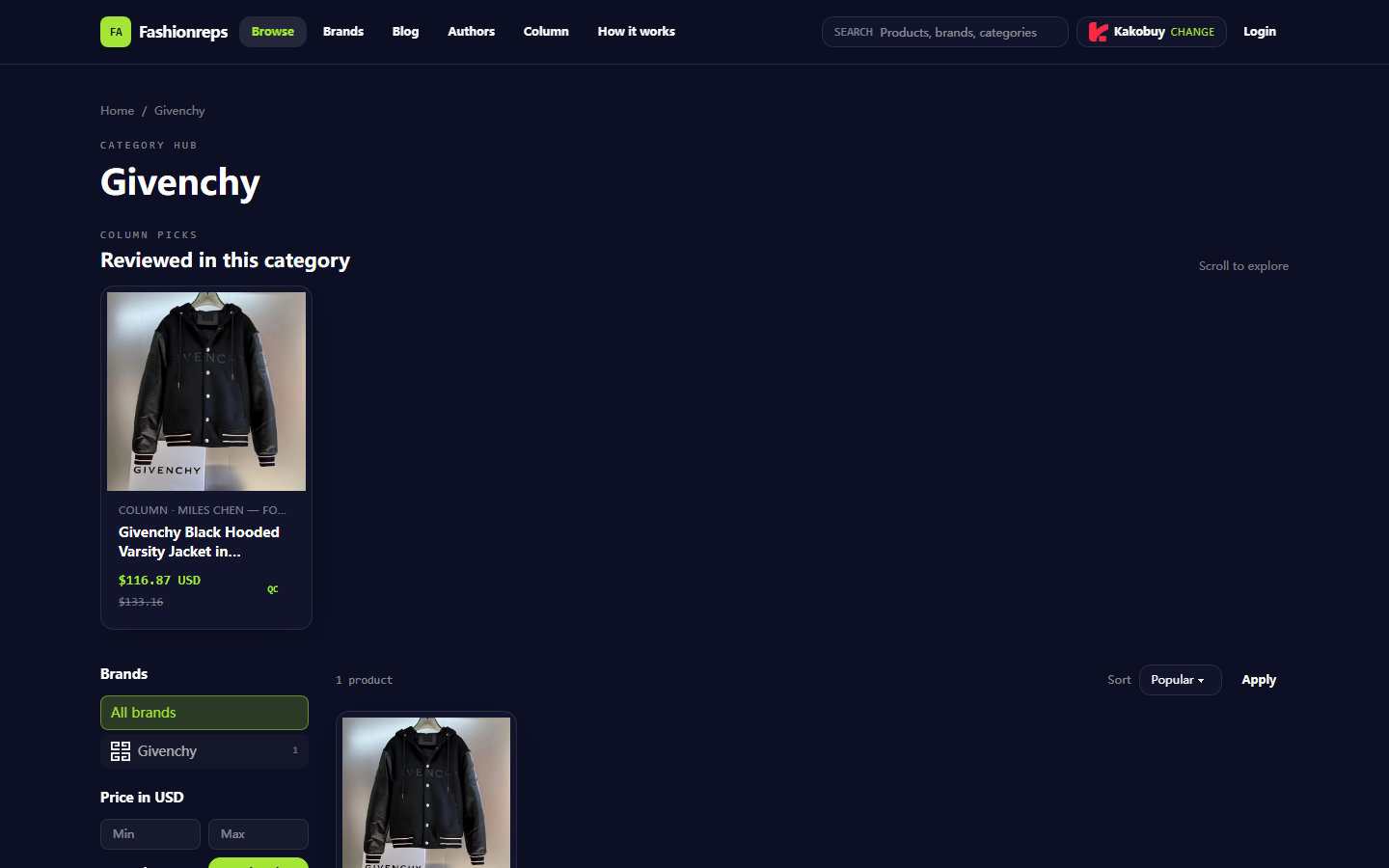
The current visible Givenchy category evidence on Fashionreps shows that the page includes brand categories, editor's picks, and product filtering functions; the visible sample is a Givenchy black hooded baseball jacket with S–3XL and reference price information in the title. This record cannot directly prove the existence of the same fall/winter knit top, nor can it prove that the knit top has the same sizing, price, or stock. Therefore, the knit top should be rechecked on a per-product-page basis and not inferred from adjacent categories.
How to Compare Fit, Size Chart, and Product Images Item by Item
Fit judgment should rely primarily on measurements and structural images, not on adjectives in the title such as relaxed, slim, or oversize. The title can serve as a clue but cannot replace measurement.
First, check whether the size chart lists both length and width data such as garment length, chest or half-chest, shoulder width, sleeve length, and hem width. Different pages may use full circumference measurements, flat measurements, or manual measurements; the definition of the numbers must be confirmed. If only letter sizes such as S, M, L are provided without specific centimeter data, only rough screening is possible, and precise fit cannot be determined.
Then compare the size chart with your own reference garment:
- Choose a knit top that fits well and has a similar thickness.
- Lay it flat and measure the garment length, chest width, shoulder width, and sleeve length.
- Record the measurement method, for example, from which seam to which point.
- Compare item by item with the corresponding fields on the product page, not just one chest measurement.
- Mark items that are significantly larger and assess whether they will affect drape, cuff position, or layering space.
Fit judgment should also incorporate structural signals from the images: whether the shoulder line is dropped, whether the sleeves are wide, whether the body is short, whether the ribbed hem is tightened, whether the collar fits, and whether the model is wearing an obviously oversized inner layer. If the model's height, weight, and worn size are not clearly disclosed, do not use the proportions in the image to infer your own size.
If only part of the product page dimensions are available, it is recommended to divide the conclusion into three levels:
- Can continue comparing: key measurements are complete, measurement method is clear, and images do not significantly conflict with dimensions.
- Need to ask: there is a size chart but shoulder width, sleeve length, or error description is missing, making it impossible to judge wearing proportions.
- Suspend purchase: no specific dimensions, images cannot clearly show the structure, or the product title does not match the details content.
How Far Material, Thickness, and Fall/Winter Wear Scenarios Can Be Verified
Product photos can help judge the appearance of the knit, texture density, collar structure, and surface fuzzing, but cannot prove actual hand feel, warmth, weight, or durability. Even if the image looks thick, it cannot be written as confirmed for severe cold weather.
Material judgment should be recorded in layers:
- Confirmed: the page lists specific fiber composition and explains the content or fabric composition.
- Partially confirmed: the page only uses general terms such as wool, cotton, blend, without proportions.
- Not verified: the page only uses promotional words such as soft, thick, warm, premium, without composition or measurement basis.
Thickness also needs to be expressed cautiously. Without gram weight, thickness measurement, fabric structure description, or clear detail images, at most it can be said that the image shows a certain visual texture, and warmth level cannot be confirmed.
Fall/winter scenarios can be judged conditionally based on verifiable evidence:
- Office layering: need to confirm whether the shoulders and sleeves have room for inner layers, and check whether the hem tends to roll up.
- Weekend standalone wear: need to confirm whether the structure of the collar, cuffs, and hem is sufficient to maintain the shape; cannot only look at the front image.
- Indoor air conditioning: lightness and breathability are more important, but without relevant evidence from the page, a conclusion should not be drawn directly.
- Cold outdoor: product display images alone are insufficient to judge warmth; composition, thickness, and actual measurement information should be asked first.
Do not interpret "suitable for fall/winter" as a fixed performance conclusion. It may just be a seasonal tag on the page, which may not include destination temperature, layering method, or activity intensity. 🌡️
What Product Page, QC Images, and Community Feedback Can Each Prove
The three types of materials have different scopes of proof, and mixing them together can easily cause misjudgment.
The product page is mainly used to confirm the product name, color, size, page description, price display, and purchase entrance. It can indicate what the page says, but does not necessarily prove that the page description is completely accurate.
QC images are mainly used to check the visible condition before shipment, such as whether the color matches the selected option, whether the main structure has obvious deviations, whether the print or embroidery position is clear, and whether there are visible stains or damages. QC images are still affected by shooting angle, lighting, compression, and occlusion, and cannot prove hidden parts, wearing feel, or long-term durability.
Community feedback can help identify recurring problems, such as size deviations, a particular detail prone to errors, or differences between batches. However, a single comment cannot represent the entire product, nor can it replace the current product page and current QC images. The number of comments, posting time, discussion context, and whether it is the same style all need to be considered simultaneously.
Therefore, the purchase decision can use the following evidence order: confirm the object from the current product page, support size selection with the size chart, check visible condition with QC images, use community feedback to identify risks to be verified, and finally confirm order, stock, shipping costs, and after-sales conditions from the shopping agent page.
How to Organize Questions to Confirm When Page Information Is Insufficient
When asking the seller or shopping agent, questions should be as specific as possible, avoiding just asking "how is the quality?" A set of effective questions should correspond to a purchase decision.
You can ask:
- Is this product currently still available in the target color and size?
- Is the chest measurement in the size chart the full circumference or flat width?
- Can shoulder width, sleeve length, garment length, and hem width be provided?
- What is the usual measurement error?
- Does the material noted on the page include fiber proportions?
- Can close-up images of the collar, cuffs, hem, and fabric be provided?
- Can QC images be provided before shipment? If obvious problems are found, how is the handling window and cost calculated?
- Does the price include domestic shipping, service fees, or other additional charges?
When asking, do not send public order numbers, payment card information, passports, or complete shipping labels. If screenshots are needed, cover name, phone number, address, and payment information first. 🔒
How to Distinguish Selection Conditions for Office, Weekend, or Layering
Whether the same knit top is suitable for you depends on fit evidence and usage conditions, not the brand name itself.
For office use, it is more appropriate to prioritize checking shoulder line, sleeve length, hem stability, and collar height. If the page does not have back images or cuff detail images, a conservative judgment should be made to avoid treating the front display effect as the complete wearing effect.
For weekend wear, a looser or more designed fit is acceptable, but garment length, sleeve width, and hem dimensions should still be confirmed. Loose does not necessarily mean comfortable; overly large shoulder width and sleeve length may affect movement and increase friction when layering with outerwear.
For layering scenarios, focus on comparing body width, sleeve space, and hem closure. If the size chart only provides chest circumference without sleeve width or shoulder width, it is impossible to reliably judge whether a shirt, long-sleeve T-shirt, or thin jacket can be worn underneath.
If purchasing multiple items in one package, also consider package volume, package value, single loss risk, and shipping route restrictions. Combining packages may reduce repeated first weight or handling costs, but may increase volumetric weight and single loss risk; splitting packages may increase fixed costs but may be more suitable for dealing with route restrictions or reducing single parcel risk. Without actual shipping quotes and package data, it should not be claimed that a certain plan is necessarily more cost-effective.
Pre-Purchase Checklist and Conditions for Pausing Action
Before placing an order, you can check off item by item:
- [] Product name is clear, confirming it is the target knit top and not an adjacent category.
- [] The current link opens without redirects, blank pages, or 404.
- [] Color and size options are consistent with the purchase target.
- [] The size chart covers at least major length and width data.
- [] A flat comparison has been made with a well-fitting reference garment.
- [] The scope of proof for page description, QC images, and community feedback has been distinguished.
- [] Conclusions about material and thickness have not exceeded page evidence.
- [] Verification date, price currency, and applicable conditions have been recorded.
- [] Stock, fees, and after-sales window in the shopping agent page have been confirmed.
- [] Product page screenshot and questions to be confirmed have been saved.
Suspend action if any of the following occurs: product name does not match the image, size chart is inexplicable, no clear stock for target color or size, price difference between page and checkout page cannot be explained, QC images show obvious problems, or after-sales conditions cannot be confirmed before ordering.
Final Step: Save Evidence and Decide to Continue, Ask, or Stop
After completing the verification, there is no need to force a binary conclusion of "worth buying" or "not worth buying." A more practical result is to choose the next action:
- Continue: the product object is clear, size data is sufficient, images and page do not significantly conflict, and costs and after-sales conditions are confirmed.
- Ask: the product may meet the needs, but key dimensions, material proportions, stock, or QC information is missing.
- Stop: key evidence is missing, page status is abnormal, or risks cannot be eliminated through inquiry.
Savings should be based on actually comparable quotes, such as product price, service fee, domestic shipping, and international shipping differences between different shopping agents. It cannot be declared that a fixed amount has been saved just because of package consolidation or a reference price displayed on a page.
Increased risks should also be clearly stated: incomplete dimensions increase the risk of poor fit, unverified material increases the expectation gap in wear, package consolidation increases single parcel loss exposure, and outdated page information increases stock and price change risks.
This checking method is suitable for buyers who want to save evidence first and then decide whether to place an order; it is not suitable for those who make quick purchases based solely on brand name, model images, or a single community comment. The final decision should be based on the current product page, current QC materials, and actual settlement conditions, not on unverifiable speculation.